Liquid level mark
A bright ring around a vessel at the height its liquid started at, with a caption where the lesson asked for one. The liquid moves; the ring does not. What the student is meant to read is the gap that opens between them — or the gap that doesn’t.
Scene · the mark in place
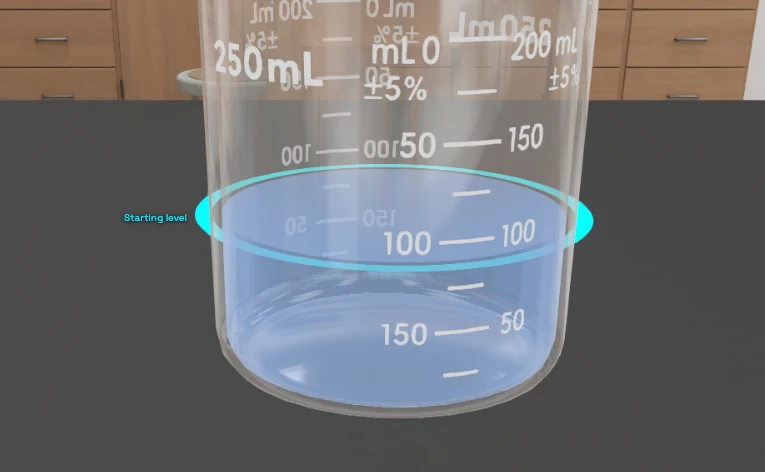
The ring lies flat on the water, so from any lab camera it projects as the same ellipse the meniscus makes against the glass — which is the shape that reads as “level” without anyone explaining it. It is drawn to the outside of the vessel, the way a line on tape would be, rather than to the width of the water itself.
A · The conceptual model
In the paper version of this lab the student puts a strip of tape down the side of a beaker and draws a line on it with a permanent marker, level with the water. Then something happens — ice melts, a solid dissolves, a second liquid is added — and they look again. The line has not moved. The water has, or it hasn’t. That comparison is the entire measurement.
The mark is that line. It is placed by the lesson author, not by the student, and once placed it never moves again for the rest of the investigation. Everything else in the scene can change around it.
Why it matters is easiest to see when it is missing. In Land Ice vs Sea Ice the student sets up two beakers: one with ice floating in the water, one with ice resting on a shelf above it. Both are left to melt. Floating ice already displaces its own weight, so that water level does not change; the ice sitting out of the water adds to it, so that one rises. Without a mark, both beakers at the end just look like beakers with water in them, and the finding — the reason sea-ice melt and land-ice melt mean different things for coastlines — is invisible.
B · What the student sees
Four moments, in order.
-
1
The scene loads
Either the ring is already there, on the water, from the first moment the vessel appears (the instance flag
mark_initial_level), or the lesson marks the vessel partway through with a step of its own (operation: mark_liquid_level), and the ring appears then, at the level the water holds at that moment. Either way there is no “place the mark” interaction and nothing to click: a student cannot add a mark, move one, or remove one. It arrives by authorial decision, like the water in the vessel. -
2
A caption, if the lesson wrote one
Where the author supplied words, a short caption sits beside the ring in the same colour. Most rings have none: there is no default text, so a lesson that says nothing gets a bare line. Where words are supplied they are deliberately not a number and not a reading; they name the line, and stop.
-
3
The investigation runs
Liquid is poured in, ice melts, a solid dissolves. The water surface moves; the ring stays exactly where it was. The ring is drawn so that it stays visible even when the water rises above it — the student can see the water standing over the old line rather than losing the line behind it.
-
4
The student reads the gap
The finding is the distance between the ring and the surface, and whether there is one at all. Nothing in the scene announces it, labels it, or does the comparison for the student. Two vessels side by side, both marked at the start, is what turns that into evidence: same starting line, one gap, one none.
C · The gap is the finding
Both vessels start identical. That is the point of marking them at the same moment — it makes the two ends comparable.
The mark does not say which of these happened, and it does not label the gap. It restores the one piece of information the scene would otherwise lose — where the water used to be — and leaves the reading to the student. Putting a measurement on it would replace an observation with a number, which is the opposite of what the lab is for.
D · The caption
Opt-in. A caption appears where the lesson authored a mark_label and nowhere else — there is no default text, so an ordinary marked vessel carries a bare ring. Where words do appear they are small, in the ring’s own colour, with no plate or box behind them — the same treatment the substance labels above each vessel use, because it is the same kind of thing: a quiet name for something in the scene, not a control.
Which side it goes on
Outward. With two marked vessels on the bench, the left one’s caption sits to its left and the right one’s to its right, so the captions never compete for the space between the vessels — which is usually the narrowest space on screen and the one the student is looking through to compare. A lone marked vessel takes whichever side has more room. Either way, a caption that would run off the edge of the frame flips to the other side.
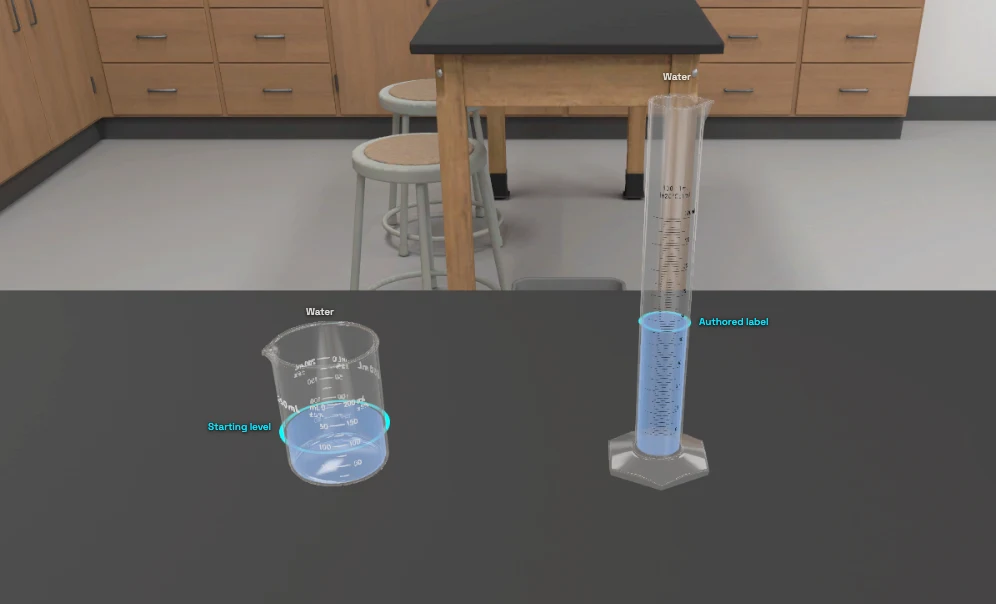
Two marked vessels, captions pointing away from each other. (The cylinder reads “Authored label” because this is the kit’s test scene, where one vessel deliberately demonstrates author-supplied wording — a real lab gives both vessels the same words.)
Why the words are the author’s, and why there is no default
The mark once captioned itself — Starting level at scene start, Marked level at a step. Those were removed: a default puts words on every marked vessel whether the lesson wanted them or not, and no fixed wording is right everywhere. “Starting level” is wrong for a mark placed before a second trial, before heating, or before a reaction. So the words are the author’s or there are none, and most rings carry none.
E · Deliberately not
- Not a number. The mark shows no volume, no height, and no difference. The finding is qualitative — the level rose, or it didn’t — and two near-identical figures would make a student do arithmetic to see something a glance already shows.
- Not a verdict. Nothing says “risen”, nothing highlights the vessel where the gap opened. Noticing is the work the lab is asking for.
- Not a control. There is nothing to press, drag or dismiss. The mark is visually separated from the placement ring a student can interact with — that one is blue, glows, and pulses; this one is cyan, flat and still.
- Not student-placed. A student cannot mark a level. The author decides which vessels are marked and when — at scene start (
mark_initial_levelon the vessel), or at a step of its own (operation: mark_liquid_levelnaming the vessel), where the ring is placed at the level that step begins with and stepping back before it takes the ring away again. One vessel may be marked at several steps — a before and an after, two rings. - Not a moving label. Once the ring is placed it holds its height for the whole investigation. It does not follow the liquid, and it does not reset between steps.
F · Where it shows up
Any vessel holding liquid when the scene starts can carry a mark; the lesson author opts each one in. It is drawn from the liquid the simulation actually renders, so the ring sits at the real surface and matches the vessel it belongs to — a wide beaker gets a wide ring, a narrow cylinder a narrow one — without the author supplying any measurement.
A vessel that is empty when the scene starts gets no mark, because there is no level to record. Marking a level partway through an investigation — after a pour rather than before it — is not yet possible; today the mark always records the starting state.
The first lab to need it is Land Ice vs Sea Ice (OpenSciEd), where the original printed procedure asks the student to mark the initial water level on tape with a permanent marker, and the digital version had no way to.